

2026 Ella Baker Summer Internship Program Announcement
From taking on the NYPD’s racially discriminatory stop-and-frisk program to challenging indefinite detention and torture at Guantánamo, Israel’s genocide of Palestinians in Gaza, and the cruel and unusual treatment of incarcerated transgender women and men by detention facilities in the South, the Center for Constitutional Rights has been on the front lines of the fight for social justice for nearly 60 years. We’re a multiracial, diverse staff committed to building the power of the people and communities we represent. Whether it’s immigration detention, racial profiling, suppression of dissent, or environmental or gender injustices in the South, we fight for human rights through the creative use of litigation and other forms of advocacy. Building upon its historic roots in the Deep South, the Center for Constitutional Rights has expanded this movement advocacy model to the South, through our Southern Regional Office, also known as CCR South, to help strengthen, support, and build the power of southern regional movements to fight oppressive power and to actualize their visions for a more equitable future.
The Ella Baker Program
The Center for Constitutional Rights created the Ella Baker Summer Internship Program in 1987 to honor the legacy of Ella Baker, a hero of the civil rights movement, and to train the next generation of social justice lawyers. Through our program, interns gain practical litigation experience and sharpen their theoretical understanding of the relationship between social change, organizing, and lawyering. Ella Baker interns also become connected to a global community of social justice law students and lawyers through our Ella Baker Alumni Network.
Intern Roles & Responsibilities
The internship has the option of being hybrid or fully remote. Interns will work under the direct supervision of Center for Constitutional Rights attorneys and others on our cases and projects. Interns also participate in training on litigation skills, movement lawyering, and other relevant topics. Interns’ responsibilities will include legal research and writing in support of our litigation, and may include factual investigation, client and witness interviews, policy/legislative research, participation in client and community meetings, and opportunities to attend court proceedings.
In the past, interns have worked on cases involving solitary confinement, discriminatory policing practices, social and economic rights, free speech, immigrants’ rights, U.S. detention and targeted killing practices, environmental justice, universal jurisdiction over international human rights abuses, gender and LGBTQIA+ justice domestically and internationally, and related work in the South in connection with the Southern Regional Office. Interns have also had the opportunity to work on various advocacy campaigns.
Program Dates
The internship will begin on Tuesday, June 2, 2026, and end on Friday, August 7, 2026. Ella Baker interns are expected to work 40 hours per week.
Intern Qualifications
- Students must have completed their second year of law school by summer of 2026. The Center for Constitutional Rights does not accept law graduates in the Ella Baker program.
- Experience and/or a demonstrated commitment to racial justice, gender justice, civil rights, international human rights, national security law, and/or social justice organizing.
- Excellent legal research and communication skills.
Compensation
Because we have limited resources, the Center for Constitutional Rights requires applicants to make diligent efforts to secure summer funding from their law schools. If you are not able to get funding from your school, or your school provides funding at a lower amount than the Center for Constitutional Rights, we will provide you with summer funding or will supplement your school’s funding. If paid by the Center for Constitutional Rights, interns will be required to file a W4 to deduct state and federal taxes from your paycheck and will receive a W2 in January 2027, following your internship. Last year, the Center for Constitutional Rights funded internships up to $7500/summer. Accepted students will receive more information about this process after receiving notice of their acceptance. The Center for Constitutional Rights also provides $1000 in relocation funding for students who live outside the New York City area and are traveling to New York for the program.
Application Deadlines and Timeline
The application process opens for 2Ls on August 28, 2025 and closes on September 29, 2025 at midnight PST. Please note, we will not accept applications before August 28 or after September 29. During this period candidates will be able to complete an online application on the Center for Constitutional Rights website (ccrjustice.org) or at https://ellabakerccr.wufoo.com/forms/ella-baker-2026-summer-internship-application/. Once the website link is live, students will be prompted to upload the following documents as a single PDF, named “[Last name], [First name] Application”:
⮚ Cover Letter
⮚ Resume
⮚ Three references with contact information
If granted an interview, applicants may also be asked to submit a short legal writing sample.
Interviews for 2L applicants will be held in mid-October 2025, and 2L students should be informed in early November if they are selected. Please note, we will not be hiring 1Ls for the Ella Baker Summer Internship. The Center for Constitutional Rights only offers internships for a single term or semester (fall, spring, or summer). Students who have formerly interned with us are not eligible to apply for another term.
Why is the Internship Named After Ella Baker?
Ella Baker devoted her life to social change. During the Depression she organized consumer cooperatives and wrote, taught, and lectured on consumer affairs for the Federal Works Progress Administration. In the 1940’s she traveled throughout the South organizing chapters of the NAACP. She was an early executive director of the Southern Christian Leadership Conference, led by the Rev. Dr. Martin Luther King, Jr.
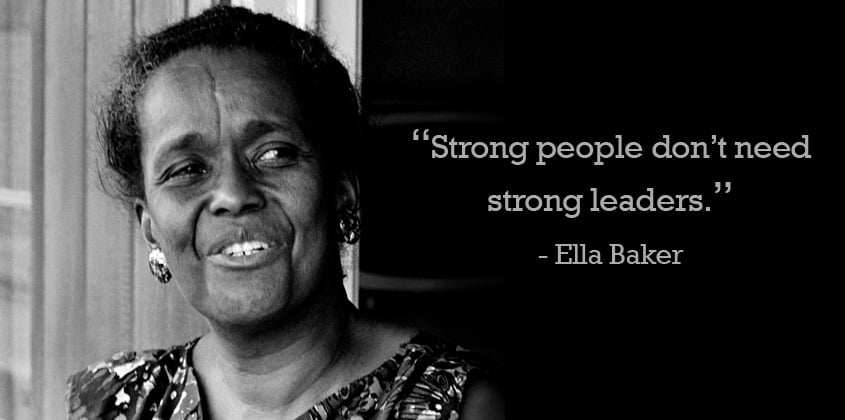
Ella Baker strongly believed that community members and young people could make significant changes in their lives. She said, “My theory is, strong people don’t need strong leaders.” She seldom appeared on television or in news stories, explaining that, “The kind of role that I tried to play was to pick up pieces or put together pieces out of which I hoped organization might come.” Many consider her greatest influence to be with the Student Nonviolent Coordinating Committee (SNCC). As an advisor to SNCC members who were generations younger, she rarely intervened, although her advice was often sought. She said, “Most of the youngsters had been trained to believe in or to follow adults if they could. I felt they ought to have a chance to learn to think things through and to make decisions.”
The Center for Constitutional Rights is proud to honor her life and memory with the Ella Baker Summer Internship Program. It is our hope that many young people will be inspired to follow in her footsteps.
For more Information
If you have questions about the Ella Baker Program, please contact: [email protected]
THE CENTER FOR CONSTITUTIONAL RIGHTS IS AN EQUAL OPPORTUNITY/AFFIRMATIVE ACTION EMPLOYER AND ACTIVELY RECRUITS WOMEN, PEOPLE OF COLOR, PERSONS WITH DISABILITIES, AND LGBTQIA+ AND GENDER NON-CONFORMING PEOPLE.